

Preamble
For the past 2-3 years, I’ve been dealing with a litany of health issues that have compounded on top of some pre-existing conditions I already was dealing with. After catching Covid in late 2023, I began a slow descent into a number of Long Covid symptoms that ramped up in 2025, when my cognitive symptoms noticeably affected my ability to enjoy the hobbies that I used to avidly engage with. Playing videogames gave me headaches, stringing sentences together for simple blog posts was an uphill battle due to intense brain fog, and the amount of time I spent resting in bed went up exponentially. The weekends that I used to spend making keyboard Youtube videos, soldering countless PCBs for client builds, and photographing bands at concerts were instead replaced with long days lying in bed with nothing but myself and music. I pushed myself occasionally to attend conventions and meetups, but I more often than not would have to say no whenever I was invited to go somewhere. My body no longer had the capacity for the life I once lived.
It had all come to a head when I was helping my parents walk their two dogs for a few days while they were out of town. One of them, Fraiser, was a ball of infinite energy. He would constantly pull on his leash for me to walk faster, looking back at me expectantly. Back before Covid, I used to run him for multiple blocks every day. Now, moving my body that much felt like trying to drag a bag of bricks. The next day, as I tried to get out of bed, I collapsed to the floor. My body was unbelievably weak, unable to recuperate from how much I had pushed myself. It felt like I had run multiple marathons, even though all I did was run around the block. With my last bits of energy, I texted a friend who thankfully lived nearby to come help me till my parents returned. I spent the next week recovering in bed, hardly moving, and barely able to tolerate music or light.
During those next few months, I spent more time in the audiophile scene, listening to music with IEMs and chatting with fellow audiophiles in the various forums and servers. I found the hobby to be less taxing on my body, and it kept me engaged in a community from the comforts of my room.
For the uninitiated, IEMs, known also as In-Ear Monitors, were invented in the 1980s and became widespread in the 90s amongst performing musicians who needed to monitor their voice and instruments while playing in large venues and stadiums. It helped to prevent hearing damage with its shells custom-fitted to each performer’s ear, while also providing the clarity needed to keep a band playing together in sync. This, alongside improvements in loudspeaker systems, transformed the concertgoing experience into what it is today.
This technology trickled down into consumer goods, at first with simple wired earbuds such as the Sony MDR models and Apple Earpods, and then towards “pro-sumer,” universal-shell IEMs from brands like Shure, Ultimate Ears, Westone, Sennheiser, Etymotic, and others. By the 2010s, brands across Asia were also beginning to catch on, revolutionizing the enthusiast and audiophile scene with even lower prices and more variety.
As for me and my health, I’ve learned to pace myself, having found where the limits of my body’s energy lies. A number of various treatments that I’ve tried have also recovered some bits of the energy that I thought I had lost forever. Some weeks, I can attend events and see friends, but other times, I have to recover in bed with nothing but the music and my thoughts. My life has slowed down quite a bit, and in a similar way, I’ve learned to slow down and appreciate the nuances in every song I listen to. IEMs bring a level of clarity and immersion that I never had with my Sony XM3 headphones or Apple earpods. Even if just for a song, I can put in my IEMs and escape into the sounds, away from my body.
Introduction to Yu9
Yu9, also known as Fish 9, is a Chinese IEM brand that was born out of one hobbyist’s love of IEMs. Having started with a line of Etymotic-style IEMs, Yu9 more recently found breakout success with their Que model, which surprisingly is also Yu9’s first multi-driver IEM. Priced at $399 USD, Yu9 Que is a 1 DD + 3 BA IEM. The buzz Yu9 Que has created, however, hasn’t been entirely positive, with there being some mixed opinions on its apparent neutral/bright tuning. These conflicting impressions piqued my curiosity, and so, I had to find out for myself: Is it the giant killer as some profess, or is it yet another overhyped IEM?
My unit of Yu9 Que was bought secondhand with my own money.
Unboxing
Yu9 Que comes in a cube-like box, with some decent accessories inside. With the Que, you’ll find two types of eartips, some protective cloth pouches for each IEM, a carrying case, and a non-interchangeable cable that varies between 3.5mm or 4.4mm depending on the model you buy. The carrying case is sturdy and large, capable of carrying quite a number of items inside. The eartips are decent enough, with a KBear07/AET07 style set of eartips, and some liquid silicone eartips. The cable is fairly simple for its price, being non-interchangeable, but also visually simplistic, being a thin, 2-core cable. It isn’t microphonic, and it isn’t too stiff, but for $399, I was expecting something a bit nicer.

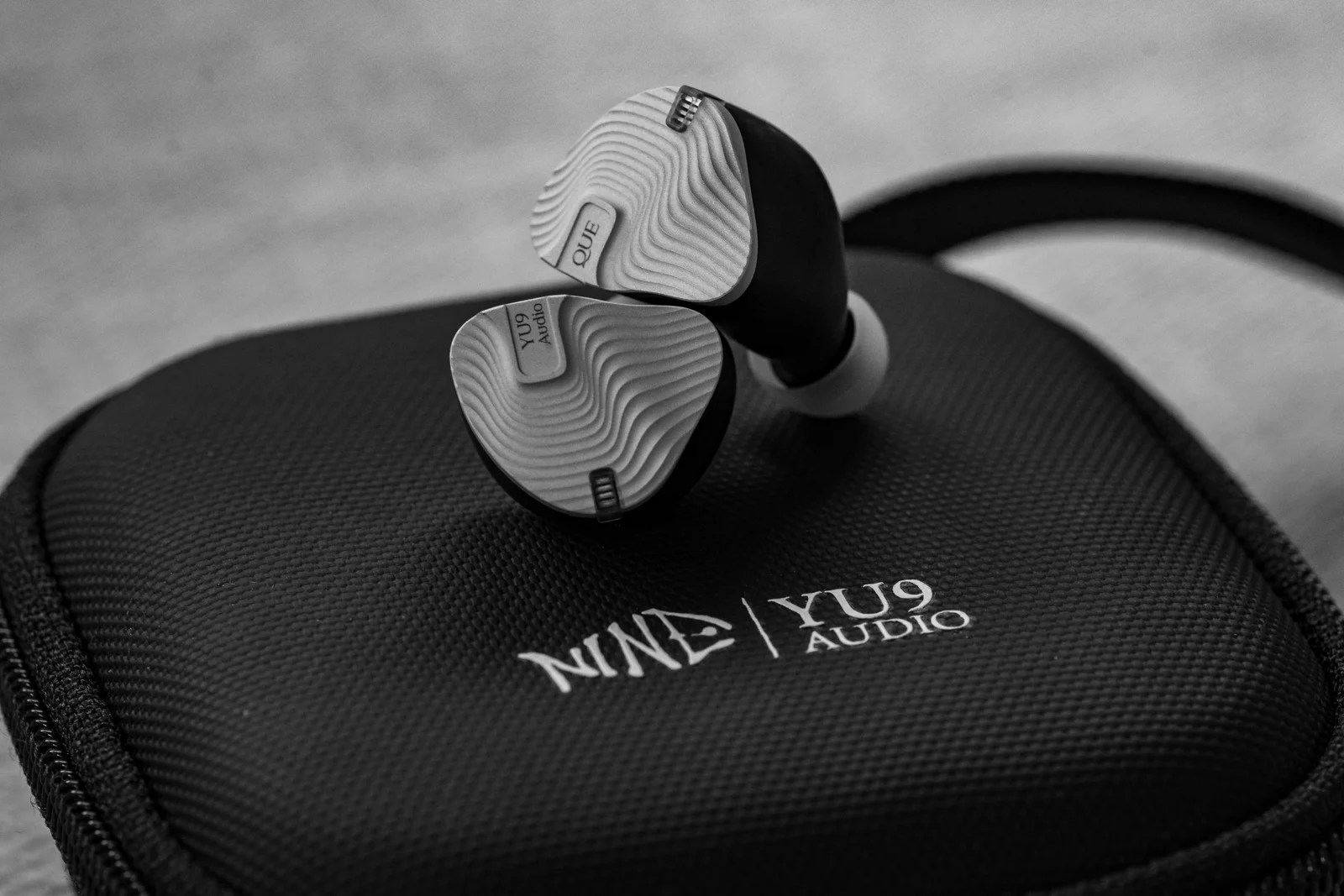
The shell itself, in my opinion, is subtle in how stunning it is. The faceplate is aluminum, sand-blasted with a silvery matte coating, and engraved with a wave-like pattern. The faceplate design, alongside its rough, concrete-like texture, has an industrial feel to it. These design elements, however, are interrupted by an opaque plastic accent that juts out from the side, almost like a diffuser meant to channel light through it. Que, however, emanates no such light when plugged in. The superficiality of the diffuser, to me, evokes the idea of a utilitarian tool transformed into a luxurious statement piece. Initially, the diffuser may seem unnecessary and perhaps even ruins the aesthetic for some people. Instead, it serves as a reminder of what IEMs have become, and the purpose that they serve for us enthusiasts.
Philosophically, engaging in this hobby relates to my interest in hedonism, in that, I believe our lives should be spent indulging in our pleasures and experiencing our reality to the fullest extent. For me, listening to music on high quality IEMs is a part of that worldview. Music immerses and fulfills you in a way that is both universal and primal; playing and listening to music is innate to the human condition. In less than a lifetime, IEMs have gone from custom-molded, highly specialized devices completely out of reach from the average consumer, to stunning resin or metal pieces of art — chock-full with all kinds of drivers, tubes, and wires — that we put in our ears for our enjoyment.

In our modern society of course, these pleasures don’t come freely. There are still parts of our life that require moderation and self-discipline. Those qualities, in some part, led to many of the advancements in the IEM world. Hobbyists, such as the founder of Yu9, dedicate years of their life to honing their craft and learning the skills necessary to create the expertly crafted IEMs that we have the privilege to use today.
It’s not all sunshine and rainbows though with its shell. Beyond its faceplate is a relatively bulky shape and a thick nozzle made of resin. Even for my large ears, getting a comfortable fit was a difficulty at first. I planned to just use the included liquid silicone eartips, but I found it uncomfortable regardless of the size that I used. The normal silicone eartips that came with the Que were also not large enough to seal in my ears. For the first 2-3 days, I ended up using some Whizzer SS20 eartips that are short wide bores. But even then, it slowly began to feel too snug, so I then tried my Kbear07s, and I guess this time I was able to get a better fit. The shape ultimately is still not as comfortable as it could be, as even with all of my eartip rolling, my ears do get a little sore if I wear them for too long.
Sound Impressions
The first time I gave Yu9 Que a listen, I honestly wasn’t sure what to expect. The graph showed one thing, and people’s impressions said another. To my ears, Yu9 Que is a surprisingly engaging, technical-leaning, and balanced sound signature with treble that isn’t afraid to show the flaws in a track and a more restrained but still deeply impactful bass. It really isn’t “neutral”, but it isn’t bright-leaning either. The most apt description of it, to me at least, would be a mild U-shape tuning, as the mids don’t feel as well highlighted or forward compared to some other tuning styles, with its bass impact and treble shimmer taking a more obvious center stage.
Bass
While in a sense Yu9 Que is more mid-bass forward, sub-bass plays a crucial yet sometimes unnoticed role, adding a level of depth, texture, and subdued rumble during the tracks that require it. It’s nimble and quick to resolve, which makes it come across perhaps lighter in the bass, especially on EDM or Rap tracks, where the more drawn out and exaggerated types of sub-bass tend to be preferred. “Mutt That Bih” by Denzel Curry can sound lacking, with Que’s sub-bass sounding correctly textured but not lingering too long. Yu9 Que, in that sense, is not as satisfying, sometimes resolving its bass notes too quickly for the listener to register that they were even there to begin with. Not every track has this sort of feeling, however. Classic tracks like Angel by Massive Attack have properly deep hitting and textured bass notes, from the underlying synth bass line, to the electronic kickdrum beat, to the acoustic drums. Each section of the bass feels well separated from one another, with no midbass bleed.
It’s a very technical take on the bass section that doesn’t feel entirely incapable of having fun. There is an emphasis on the tightness to each note, but given the right opportunity, it is capable of showing off its skill. Particularly on the more acoustic kickdrums and bass lines, Que really shines, with a solid amount of thickness and heft to each hit.
Midrange
In comparison to some warmer or more bass-heavy tunings, Que’s midrange is quite clean with a subtle coloring to it that gives its leaner exterior a musical undertone. Lower mids are properly represented with good clarity, and this continues into the upper mids, though vocals specifically come across with a more clinical correctness compared to instrument presentation. Every breath and every falter can be heard in both male and female vocals, which comes at the cost of more poorly produced songs not having their mistakes covered by any amount of midrange warmth. “Emily” by From First to Last is an acoustic emo song from 2004 with a below average studio recording, and the vocals have a little bit of an echo and lack in fullness. This isn’t something I necessarily attribute however to Que being “bad” at presenting vocals, though vocals also are not always very forward, as it fully depends on the recording itself. On the flip side, the detail here is impressive, hearing the coarseness in his voice as he amateurishly belts into the mic, and the quick inhales between notes.
Songs like “Better Than I Imagined” by Robert Glasper, meanwhile, really show off just how good vocals can sound on Que, even without the intense coloration. H.E.R and Meshell Ndegeocello’s voices sound full and detailed, singing right into your ears. The vocals now emphasize the much more modern, studio conditions it was recorded in — especially during Ndegeocello’s spoken word section, with her vocals feeling more intimate and a heftiness to her voice.
Spatially, Yu9 Que is extremely competent with making sure each instrument is properly represented. In “Nothing Burns Like the Cold” by Snoh Aalegra, the trumpets are staged somewhat far from your ear, as if being played across from you in a large hall, while the strings sit closer to you, and the piano quietly pierces through the mix in another corner to the side. The song practically engulfs you and Que makes good use of such a well-mixed song.
“Erik’s Song” by Slowdive creates a melancholic soundscape with the quiet rumbling of a thunderous rainstorm that feels as though it’s coming from above, alongside a distant sounding piano and guitar. The layering and soundstage here is incredible, elevating a track that can come across plodding and dull if not played on something capable of bringing out the song’s subtleties.
Treble
Que’s treble is perhaps its most divisive element, with certain eartips and insertions creating too much shimmer up top, detracting from the rest of the frequency range and ultimately being too fatiguing to use for long periods of time. This was the case for me at first. I loved the midrange presentation, and the technical capability of this IEM blew me away, but the percussion ultimately was so sharp that it made it hard to focus on the other elements. This is what makes this a difficult IEM to blindly recommend to people, as it is so dependent on insertion depth and tip choice. It was only after some tip rolling and more fiddling with the IEMs in my ear that this splashiness subsided, and the greatness of its treble finally revealed itself. It’s still no doubt a shimmery treble that I would not classify as straightforwardly non-fatiguing. Songs like “Crash Out” by Tinashe, with its electronic drum beat, can be a little much up top, but I don’t find this to be the case with every pop/electronic song. “Dancing with your eyes closed” by Jane Remover, despite its chaotic production and sound effects, is much more under control, never sounding harsh.
In the same breath, despite the forwardness of the treble, its treble detail is not where the Que magic lies. The treble extension helps with the sharpness and definition of each note, but I don’t find that it pulls out as much nuance or detail as the midrange or even the bass.
Technical Ability
As stated previously, Que’s imaging and sense of space are exceptionally adept. It’s really what elevates its leaner, more clinical tonality into something capable of sounding so musical. On the right tracks, Que is downright holographic with its soundstage, but it also can’t create space out of thin air. Well-produced tracks flourish on the Que, while ones with a less competent mix don’t get the same treatment when it comes to spaciousness and depth. Simply put, Que can only put out what you put in.
Additionally, Que has the instrument separation and agility to deal with more complex tracks and denser genres, such as metal, with surprising ease. “Restricted (R18+)” by Alpha Wolf sounds the cleanest it ever has, with each kickdrum hit feeling incredibly precise, and the thick walls of guitar lines and vocals just as well represented, never bleeding into one another.
Source Pairing
While I found it to sound quite good on my usual neutral sources of Fosi K7 and Qudelix 5k, it’s when I plugged it into my Muse M3 Ultra, a portable tube dac/amp, that I really fell in love with the Que. I’m admittedly a bit of a bass and warmth enjoyer, and at first glance, Yu9 Que isn’t my usual pick of the crop. It’s at times too revealing and too restrained in the bass for my liking. Muse M3 Ultra however fixes this, and even takes Que to a new level.
Bass, and especially sub-bass, becomes more pronounced and digs deeper, while the treble smooths out ever so slightly up top. Vocals also gain a nice bit of warmth and thickness.
The combination results in a slightly warmer but still just as technically capable sound that is well-suited for some of the bassier genres like EDM and Rap, as well as tracks that aren’t mixed as cleanly.
Comparison to Ziigaat Odyssey ($229 USD)
Unlike Yu9 Que, Odyssey’s overt midrange warmth and coloration covers up most faults in any mix. It comes, of course, at the expense of some micro-detail, but the result is an IEM that is immersive without breaking the illusion. It’s a tradeoff that is sometimes worth it, especially for genres like 2000s emo or punk, when entire discographies are littered with poorly mixed songs. On the other hand, the more refined tracks never get to shine as clearly, with a noticeable lack in bass tightness and detail, as well as less competent instrument separation. Treble is better extended on Que, but Odyssey’s still sounds very natural despite it not having those final bits of air. Soundstage however is a toss-up here; Odyssey’s soundstage feels rounder and more immersive, while Yu9 Que has better imaging and can more accurately recreate the actual recording conditions of a song.
Que versus Odyssey has been interesting to compare. Both succeed in their own areas without nullifying the other. They contrast each other wonderfully in a way that makes me happier to own both rather than only one.
Conclusion

So, what exactly does Que bring to the table? It isn’t neutral, or “monitor-like” in the same way as Crinear Reference or Softears Studio 4, but it also doesn’t paint the music with rose-colored glasses. The shell as well can be ill-fitting for smaller ears, and its treble too much for more sensitive listeners. What you get though, if those aspects don’t deter you, is a uniquely clear and vibrant picture of each track.
When my health really took a turn for the worst, I found it difficult at first to feel anything but despair. Whatever life was left for me felt like barely a sliver of what I used to have. But, in order to get through those times, I knew I had to shift my perspective: Life is difficult right now, but my loved ones are still there for me, I’m still alive, and there is always a tomorrow.
Que, at its core, is a perspective shift. It doesn’t necessarily lie to you, but it won’t focus just on the flaws either. Even if you can’t see it at first, there is always beauty and hope to be found, and Que has helped me to realize that.
For more information on Yu9 and its founder, feel free to watch this interview here: